Note
Go to the end to download the full example code.
Park a Truck with Two Trailers
Objective
Show how to use the
variable bounds featureofopty.
Description
A truck with two trailers hitched to it is parked somewhere. It has to move backwards into a parking spot. The truck has rear wheel drive and front steering. Truck and trailers are modeled as rods of length \(l_1, l_2, l_3\), and masses \(m_1, m_2, m_3\). the wheels are modeled as point masses of mass \(m_w\); the axles have length \(2 \cdot l_{ax}\). The truck and trailers are conneted to a tow bar, ligidly fixed to the front axle of each trailer. The tow bars have length \(l_d\). The driving force and the steering torque are the controls.
The tractor / trailer arrangement must be approximately straight in the parking spot, but not completely so. Hence adjustable bounds are used to allow for larger angles during the trip and smaller ones when parking.
Notes
The idea is from Jason Moore, private communication.
While the released version of opty is 1.5.0, the developmental version of opty must be used to run the code.
States
\(q_{10}, q_{20}, q_{30}\) : angles of the truck and trailers. \(q_{10}\) w.r.t. the inertial frame, \(q_{20}, q_{30}\) w.r.t. the truck and first trailer, respectively.
\(q_{11}, q_{21}, q_{31}\) : angles of the axles of the truck and trailers, respectively. \(q_{i1}\) w.r.t.:math:q_{qi0}.
\(x, y\) : position of the truck’s mass center.
\(u_{10}, u_{20}, u_{30}\) : angular velocities of the truck and trailers.
\(u_{11}, u_{21}, u_{31}\) : angular velocities of the axles of the truck and trailers.
\(u_x, u_y\) : velocity of the truck’s mass center.
Controls
\(\vec F\) : driving force.
\(\overrightarrow{Torq}\) : steering torque.
Parameters
\(m_1, m_2, m_3\) : masses of the truck and trailers.
\(m_w\) : mass of the wheels.
\(l_1, l_2, l_3\) : lengths of the truck and trailers.
\(l_d\) : length of the tow bars.
\(l_{ax}\) : half the length of the axles.
\(g\) : gravitational acceleration.
\(w_i, d_i\) : width and depth of the parking spot, modeled as a negative hump.
\(\text{reibung}\) : coefficient of the speed dependent friction between the truck/trailers and the ground.
Others
\(N\) : inertial frame.
\(A_{i0}\) : body fixed frame of the \(i^{th}\) vehicle.
\(A_{i1}\) : frame of the axles of the \(i^{th}\) vehicle.
\(O\) : origin of the inertial frame.
\(Dmc_i\) : mass center of the \(i^{th}\) vehicle.
\(P_{if}, P_{ib}\) : front and back point of the \(i^{th}\) vehicle.
\(P_{ifl}, P_{ifr}, P_{ibl}, P_{ibr}\) : left and right points of the axles of the \(i^{th}\) vehicle.
import sympy as sm
import sympy.physics.mechanics as me
import numpy as np
import matplotlib.pyplot as plt
from matplotlib.patches import FancyArrowPatch
import time
from opty import Problem
from scipy.interpolate import interp1d
from matplotlib.animation import FuncAnimation
Kanes Equation of Motion
Geometry
start_time = time.time()
N, A10, A11, A20, A21, A30, A31 = sm.symbols(
'N A10 A11 A20 A21 A30 A31', cls=me.ReferenceFrame)
O = me.Point('O')
O.set_vel(N, 0)
t = me.dynamicsymbols._t
Dmc1, P1f, P1b, Dmc2, P2f, P2b, Dmc3, P3f, P3b = sm.symbols(
'Dmc1 P1f P1b Dmc2 P2f P2b Dmc3 P3f P3b', cls=me.Point)
P1fl, P1fr, P1bl, P1br = sm.symbols(
'P1fl P1fr P1bl P1br', cls=me.Point)
P2fl, P2fr, P2bl, P2br = sm.symbols(
'P2fl P2fr P2bl P2br', cls=me.Point)
P3fl, P3fr, P3bl, P3br = sm.symbols(
'P3fl P3fr P3bl P3br', cls=me.Point)
q10, q11, q20, q21, q30, q31 = me.dynamicsymbols('q10 q11 q20 q21 q30 q31')
u10, u11, u20, u21, u30, u31 = me.dynamicsymbols('u10 u11 u20 u21 u30 u31')
x, y, ux, uy = me.dynamicsymbols('x y ux uy')
F, Torq = me.dynamicsymbols('F Torq')
Parameters.
m1, m2, m3, mw, l1, l2, l3, ld, lax, g, reibung = sm.symbols(
'm1 m2 m3 mw l1 l2 l3 ld lax g reibung')
Orient the body fixed frames and set their angular velocities.
A10.orient_axis(N, q10, N.z)
A10.set_ang_vel(N, u10 * N.z)
A11.orient_axis(A10, q11, N.z)
A11.set_ang_vel(A10, u11 * N.z)
A20.orient_axis(A10, q20, N.z)
A20.set_ang_vel(A10, u20 * N.z)
A21.orient_axis(A20, q21, N.z)
A21.set_ang_vel(A20, u21 * N.z)
A30.orient_axis(A20, q30, N.z)
A30.set_ang_vel(A20, u30 * N.z)
A31.orient_axis(A30, q31, N.z)
A31.set_ang_vel(A30, u31 * N.z)
Define the various points and set their velocities.
The truck.
Dmc1.set_pos(O, x * N.x + y * N.y)
Dmc1.set_vel(N, ux * N.x + uy * N.y)
P1f.set_pos(Dmc1, l1/2 * A10.x)
P1f.v2pt_theory(Dmc1, N, A10)
P1b.set_pos(Dmc1, -l1/2 * A10.x)
P1b.v2pt_theory(Dmc1, N, A10)
P1fl.set_pos(P1f, lax * A11.y)
P1fl.v2pt_theory(P1f, N, A11)
P1fr.set_pos(P1f, -lax * A11.y)
P1fr.v2pt_theory(P1f, N, A11)
P1bl.set_pos(P1b, lax * A10.y)
P1bl.v2pt_theory(P1b, N, A10)
P1br.set_pos(P1b, -lax * A10.y)
_ = P1br.v2pt_theory(P1b, N, A10)
Trailer 1.
P2f.set_pos(P1b, -ld * A21.x)
P2f.v2pt_theory(P1b, N, A21)
Dmc2.set_pos(P2f, -l2/2 * A20.x)
Dmc2.v2pt_theory(P2f, N, A20)
P2b.set_pos(Dmc2, -l2/2 * A20.x)
P2b.v2pt_theory(Dmc2, N, A20)
P2fl.set_pos(P2f, lax * A21.y)
P2fl.v2pt_theory(P2f, N, A21)
P2fr.set_pos(P2f, -lax * A21.y)
P2fr.v2pt_theory(P2f, N, A21)
P2bl.set_pos(P2b, lax * A20.y)
P2bl.v2pt_theory(P2b, N, A20)
P2br.set_pos(P2b, -lax * A20.y)
_ = P2br.v2pt_theory(P2b, N, A20)
Trailer 2.
P3f.set_pos(P2b, -ld * A31.x)
P3f.v2pt_theory(P2b, N, A31)
Dmc3.set_pos(P3f, -l3/2 * A30.x)
Dmc3.v2pt_theory(P3f, N, A30)
P3b.set_pos(Dmc3, -l3/2 * A30.x)
P3b.v2pt_theory(Dmc3, N, A30)
P3fl.set_pos(P3f, lax * A31.y)
P3fl.v2pt_theory(P3f, N, A31)
P3fr.set_pos(P3f, -lax * A31.y)
P3fr.v2pt_theory(P3f, N, A31)
P3bl.set_pos(P3b, lax * A30.y)
P3bl.v2pt_theory(P3b, N, A30)
P3br.set_pos(P3b, -lax * A30.y)
_ = P3br.v2pt_theory(P3b, N, A30)
Form the bodies and the force.
IZZtruck = 1/12 * m1 * l1**2
IZZtrailer1 = 1/12 * m2 * l2**2
IZZtrailer2 = 1/12 * m3 * l3**2
I_truck = me.inertia(A10, 0, 0, IZZtruck)
I_trailer1 = me.inertia(A20, 0, 0, IZZtrailer1)
I_trailer2 = me.inertia(A30, 0, 0, IZZtrailer2)
truck = me.RigidBody('Truck', Dmc1, A10, m1, (I_truck, Dmc1))
trailer1 = me.RigidBody('Trailer1', Dmc2, A20, m2, (I_trailer1, Dmc2))
trailer2 = me.RigidBody('Trailer2', Dmc3, A30, m3, (I_trailer2, Dmc3))
P1fla = me.Particle('P1fla', P1fl, mw)
P1fra = me.Particle('P1fra', P1fr, mw)
P1bla = me.Particle('P1bla', P1bl, mw)
P1bra = me.Particle('P1bra', P1br, mw)
P2fla = me.Particle('P2fla', P2fl, mw)
P2fra = me.Particle('P2fra', P2fr, mw)
P2bla = me.Particle('P2bla', P2bl, mw)
P2bra = me.Particle('P2bra', P2br, mw)
P3fla = me.Particle('P3fla', P3fl, mw)
P3fra = me.Particle('P3fra', P3fr, mw)
P3bla = me.Particle('P3bla', P3bl, mw)
P3bra = me.Particle('P3bra', P3br, mw)
bodies = [truck, trailer1, trailer2, P1fla, P1fra, P1bla, P1bra, P2fla,
P2fra, P2bla, P2bra, P3fla, P3fra, P3bla, P3bra]
FL = [(P1b, F * A10.x), (A11, Torq * N.z),
(Dmc1, - reibung * m1 * g * Dmc1.vel(N)),
(Dmc2, - reibung * m2 * g * Dmc2.vel(N)),
(Dmc3, - reibung * m3 * g * Dmc3.vel(N))]
Kinematic differential equations.
kd = sm.Matrix([
q10.diff(t) - u10,
q11.diff(t) - u11,
q20.diff(t) - u20,
q21.diff(t) - u21,
q30.diff(t) - u30,
q31.diff(t) - u31,
ux - x.diff(t),
uy - y.diff(t),
])
Speed constraints: No speed in direction of the axles.
speed_constr = sm.Matrix([
P1f.vel(N).dot(A11.y),
P1b.vel(N).dot(A10.y),
P2f.vel(N).dot(A21.y),
P2b.vel(N).dot(A20.y),
P3f.vel(N).dot(A31.y),
P3b.vel(N).dot(A30.y)
])
Form the equations of motion.
q_ind = [q10, q11, q20, q21, q30, q31, x, y]
u_ind = [u11, ux]
u_dep = [u10, u20, u21, u30, u31, uy]
kanes = me.KanesMethod(
N,
q_ind,
u_ind,
kd_eqs=kd,
u_dependent=u_dep,
velocity_constraints=speed_constr,
)
fr, frstar = kanes.kanes_equations(bodies, FL)
eom = kd.col_join(fr + frstar)
eom = eom.col_join(speed_constr)
Add additional constraints.
Form the negative hump of width 2*wi and depth di.
wi, di, steep = sm.symbols('wi di steep')
def smooth_hump(x, wi, di, steep=25):
"""returns -di if x is between -wi and wi, and 0 otherwise, with a
smooth transition determined by steep"""
return - 0.5 * di * (sm.tanh(steep * (x + wi)) -
sm.tanh(steep * (x - wi)))
Wheels and mass centers must be above the hump.
alg_eqs = sm.Matrix([
P1fl.pos_from(O).dot(N.y) - smooth_hump(P1fl.pos_from(O).dot(N.x), wi, di),
P1fr.pos_from(O).dot(N.y) - smooth_hump(P1fr.pos_from(O).dot(N.x), wi, di),
P1bl.pos_from(O).dot(N.y) - smooth_hump(P1bl.pos_from(O).dot(N.x), wi, di),
P1br.pos_from(O).dot(N.y) - smooth_hump(P1br.pos_from(O).dot(N.x), wi, di),
P2fl.pos_from(O).dot(N.y) - smooth_hump(P2fl.pos_from(O).dot(N.x), wi, di),
P2fr.pos_from(O).dot(N.y) - smooth_hump(P2fr.pos_from(O).dot(N.x), wi, di),
P2bl.pos_from(O).dot(N.y) - smooth_hump(P2bl.pos_from(O).dot(N.x), wi, di),
P2br.pos_from(O).dot(N.y) - smooth_hump(P2br.pos_from(O).dot(N.x), wi, di),
P3fl.pos_from(O).dot(N.y) - smooth_hump(P3fl.pos_from(O).dot(N.x), wi, di),
P3fr.pos_from(O).dot(N.y) - smooth_hump(P3fr.pos_from(O).dot(N.x), wi, di),
P3bl.pos_from(O).dot(N.y) - smooth_hump(P3bl.pos_from(O).dot(N.x), wi, di),
P3br.pos_from(O).dot(N.y) - smooth_hump(P3br.pos_from(O).dot(N.x), wi, di),
Dmc1.pos_from(O).dot(N.y) - smooth_hump(Dmc1.pos_from(O).dot(N.x), wi, di),
Dmc2.pos_from(O).dot(N.y) - smooth_hump(Dmc2.pos_from(O).dot(N.x), wi, di),
Dmc3.pos_from(O).dot(N.y) - smooth_hump(Dmc3.pos_from(O).dot(N.x), wi, di),
])
eom = eom.col_join(alg_eqs)
Needed for final conditions only.
x3b, y3b = me.dynamicsymbols('x3b y3b')
ende = sm.Matrix([
x3b - P3b.pos_from(O).dot(N.x),
y3b - P3b.pos_from(O).dot(N.y)
])
eom = eom.col_join(ende)
print(f"the eoms contain {sm.count_ops(eom):,} operations and have "
f"shape {eom.shape}")
the eoms contain 51,568 operations and have shape (33, 1)
Set Up the Optimization
h = sm.symbols('h')
state_symbols = q_ind + u_ind + u_dep
num_nodes = 501
t0, tf = 0.0, h * (num_nodes - 1)
interval_value = h
Set the parameters.
par_map = {}
par_map[m1] = 1.0
par_map[m2] = 1.0
par_map[m3] = 1.0
par_map[mw] = 0.25
par_map[l1] = 1.0
par_map[l2] = 2.0
par_map[l3] = 3.0
par_map[ld] = 0.75
par_map[lax] = 0.75
par_map[g] = 9.81
par_map[wi] = 1.75
par_map[di] = 8.0
par_map[reibung] = 0.0
The truck must park as fast as possible.
def obj(free):
return free[-1]
def obj_grad(free):
grad = np.zeros_like(free)
grad[-1] = 1.0
return grad
Set the instance constraints.
instance_constraints = [
q10.func(t0) - np.pi / 2.0,
q11.func(t0) - 0.0,
q20.func(t0) - 0.0,
q21.func(t0) - 0.0,
q30.func(t0) - 0.0,
q31.func(t0) - 0.0,
x.func(t0) - 25.0,
y.func(t0) - 15.0,
u10.func(t0) - 0.0,
u11.func(t0) - 0.0,
u20.func(t0) - 0.0,
u21.func(t0) - 0.0,
u30.func(t0) - 0.0,
u31.func(t0) - 0.0,
ux.func(t0) - 0.0,
uy.func(t0) - 0.0,
x3b.func(t0) - 25.0,
y3b.func(t0) - 15 + (par_map[l3] + par_map[l2] + 2.0 * par_map[ld] +
par_map[l1]),
x3b.func(tf) - 0.0,
y3b.func(tf) + par_map[di] - 0.25,
ux.func(tf) - 0.0,
uy.func(tf) - 0.0,
u10.func(tf) - 0.0,
u11.func(tf) - 0.0,
u20.func(tf) - 0.0,
u21.func(tf) - 0.0,
u30.func(tf) - 0.0,
u31.func(tf) - 0.0,
]
While traveling the angle between two adjacent vehicles must be larger than \(\frac{\pi}{2}\), The angle of the front axles of the trailers must always be less than \(\frac{\pi}{3}\) w.r.t. the respective trailers, and the steering axle must be less than \(\frac{\pi}{4}\) w.r.t. the truck.(of course quite arbitrary values).
In the parking spot, truck/trailer arrangement should be approximately straight, but not completely so.
Hence adjustable bounds are used to allow for larger angles during the trip and smaller ones when parking.
low_bound_2 = np.array([-np.pi / 2 for _ in range(num_nodes - 30)] +
[-np.pi / 2 / i for i in range(1, 31)])
up_bound_2 = np.array([np.pi / 2 for _ in range(num_nodes - 30)] +
[np.pi / 2 / i for i in range(1, 31)])
low_bound_3 = np.array([-np.pi / 3 for _ in range(num_nodes - 30)] +
[-np.pi / 3 / np.sqrt(i) for i in range(1, 31)])
up_bound_3 = np.array([np.pi / 3 for _ in range(num_nodes - 30)] +
[np.pi / 3 / np.sqrt(i) for i in range(1, 31)])
low_bound_x3b = np.array([-25.0 for _ in range(num_nodes - 30)] +
[-0.25 for _ in range(1, 31)])
up_bound_x3b = np.array([50.0 for _ in range(num_nodes - 30)] +
[0.25 for _ in range(1, 31)])
limit = 150.0
bounds = {
h: (0.0, 0.01),
F: (-limit, limit),
Torq: (-limit, limit),
q20: (low_bound_2, up_bound_2),
q30: (low_bound_2, up_bound_2),
q11: (-np.pi/4, np.pi/4),
q21: (low_bound_3, up_bound_3),
q31: (low_bound_3, up_bound_3),
x3b: (low_bound_x3b, up_bound_x3b),
y: (-4.0, 25.0),
}
The truck and trailers must stay above the function defining the parking spot.
limit1, limit2 = 0.0, 25.0
eom_bounds = {eq: (limit1, limit2) for eq in range(16, 31)}
Set up the Problem.
prob = Problem(
obj,
obj_grad,
eom,
state_symbols,
num_nodes,
interval_value,
known_parameter_map=par_map,
instance_constraints=instance_constraints,
bounds=bounds,
eom_bounds=eom_bounds,
time_symbol=t,
)
Solve the Problem.
np.random.seed(0)
initial_guess = np.random.rand(prob.num_free)
initial_guess[6*num_nodes:7*num_nodes - int(num_nodes/5)] = \
np.linspace(25.0, 0.0, num_nodes - int(num_nodes/5))
initial_guess[7*num_nodes - int(num_nodes/5):7*num_nodes] = \
np.full(int(num_nodes/5), 0.0)
initial_guess[7*num_nodes:8*num_nodes - int(num_nodes/5)] = \
12.0 * np.sin(2*np.pi/25 * np.linspace(
25.0, 0.0, num_nodes - int(num_nodes/5))) + 15
initial_guess[8*num_nodes - int(num_nodes/5):8*num_nodes] = \
np.linspace(20.0, 0.0, int(num_nodes/5))
initial_guess[-1] = 0.01
max_iter = 3000
prob.add_option('max_iter', max_iter)
solution, info = prob.solve(initial_guess)
print(info['status_msg'])
b'Algorithm terminated successfully at a locally optimal point, satisfying the convergence tolerances (can be specified by options).'
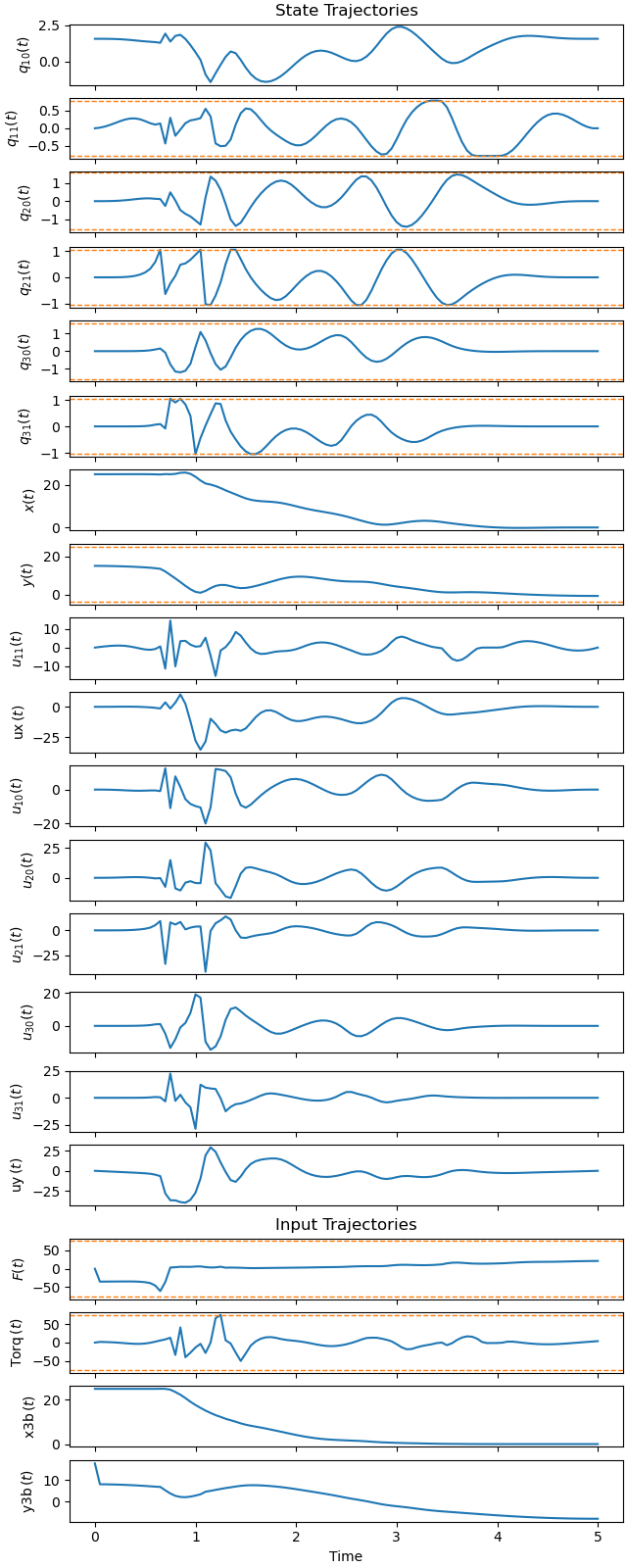
Plot the trajectories
_ = prob.plot_trajectories(solution, show_bounds=True)
Plot the errors.
_ = prob.plot_constraint_violations(solution, subplots=True, show_bounds=True)

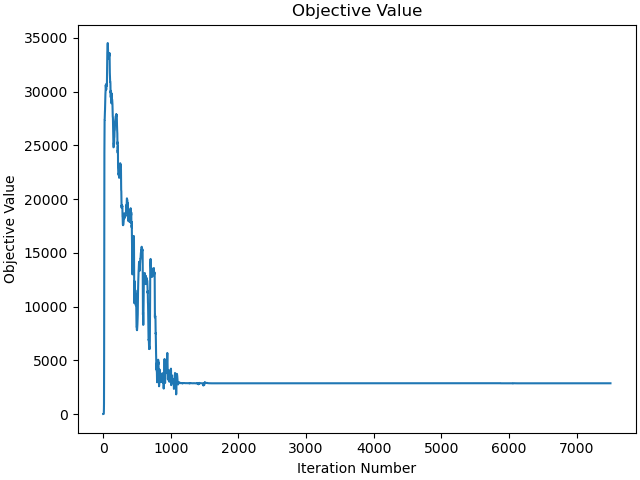
Plot the objective value as a function of the iteration.
_ = prob.plot_objective_value()
Animation
print("running the simulation took "
f"{(time.time() - start_time) / 60:.2f} minutes")
fps = 20
resultat, inputs, *_, h_val = prob.parse_free(solution)
resultat = resultat.T
inputs = inputs.T
tf = h_val * (num_nodes - 1)
t_arr = np.linspace(t0, tf, num_nodes)
state_sol = interp1d(t_arr, resultat, kind='cubic', axis=0)
input_sol = interp1d(t_arr, inputs, kind='cubic', axis=0)
pL = [key for key in par_map.keys()]
pL_vals = [par_map[key] for key in par_map.keys()]
qL = q_ind + u_ind + u_dep + [F, Torq]
# Define the end of the force_vector.
arrow_head = me.Point('arrow_head')
scale = 10.0
arrow_head.set_pos(P1b, F / scale * A10.x)
# Get the coordinates of the points in the inertial frame for plotting.
coords = Dmc1.pos_from(O).to_matrix(N)
for point in (P1f, P1b, P2f, P2b, P3f, P3b,
P1fl, P1fr, P1bl, P1br,
P2fl, P2fr, P2bl, P2br,
P3fl, P3fr, P3bl, P3br, arrow_head, Dmc1):
coords = coords.row_join(point.pos_from(O).to_matrix(N))
coords_lam = sm.lambdify(qL + pL, coords, cse=True)
smooth_hump_lam = sm.lambdify((x, wi, di, steep),
smooth_hump(x, wi, di, steep), cse=True)
fig, ax = plt.subplots(figsize=(7, 7), layout='constrained')
arrow = FancyArrowPatch([0.0, 0.0], [0.0, 0.0],
arrowstyle='-|>', # nicer arrow head
mutation_scale=20, # makes head bigger
linewidth=1,
color='green')
ax.add_patch(arrow)
# Plot the points
P1f_p = ax.scatter([], [], color='blue', s=5)
P1b_p = ax.scatter([], [], color='blue', s=5)
P2f_p = ax.scatter([], [], color='orange', s=5)
P2b_p = ax.scatter([], [], color='orange', s=5)
P3f_p = ax.scatter([], [], color='red', s=5)
P3b_p = ax.scatter([], [], color='red', s=5)
P1fl_p = ax.scatter([], [], color='blue', s=5)
P1fr_p = ax.scatter([], [], color='blue', s=5)
P1bl_p = ax.scatter([], [], color='blue', s=5)
P1br_p = ax.scatter([], [], color='blue', s=5)
P2fl_p = ax.scatter([], [], color='orange', s=5)
P2fr_p = ax.scatter([], [], color='orange', s=5)
P2bl_p = ax.scatter([], [], color='orange', s=5)
P2br_p = ax.scatter([], [], color='orange', s=5)
P3fl_p = ax.scatter([], [], color='red', s=5)
P3fr_p = ax.scatter([], [], color='red', s=5)
P3bl_p = ax.scatter([], [], color='red', s=5)
P3br_p = ax.scatter([], [], color='red', s=5)
# lines for axes
fax1, = ax.plot([], [], color='blue')
bax1, = ax.plot([], [], color='blue')
fax2, = ax.plot([], [], color='orange')
bax2, = ax.plot([], [], color='orange')
fax3, = ax.plot([], [], color='red')
bax3, = ax.plot([], [], color='red')
# Lines for the truck and trailers
truck_p, = ax.plot([], [], color='blue', lw=1)
trailer1_p, = ax.plot([], [], color='orange', lw=1)
trailer2_p, = ax.plot([], [], color='red', lw=1)
# Tow bars
towbar1_p, = ax.plot([], [], color='black')
towbar2_p, = ax.plot([], [], color='black')
# Show the actual path
Dmc1_p, = ax.plot([], [], color='gray', linestyle='-', lw=0.5)
# Size of the plot.
margin = par_map[l3] + par_map[l2] + 2.0 * par_map[ld] + par_map[l1]/2
x_max = np.max(resultat[:, 6]) + margin
x_min = np.min(resultat[:, 6]) - margin
y_max = np.max(resultat[:, 7]) + margin
y_min = np.min(resultat[:, 7]) - margin
ax.set_xlim(x_min, x_max)
ax.set_ylim(y_min, y_max)
ax.set_aspect('equal')
ax.set_xlabel('x (m)', fontsize=15)
ax.set_ylabel('y (m)', fontsize=15)
XX = np.linspace(x_min, x_max, 100)
YY = smooth_hump_lam(XX, par_map[wi], par_map[di], steep=25) - 0.25
ax.plot(XX, YY, color='black')
ax.fill_between(XX, YY, y2=y_min, color='black', alpha=0.5)
# Show the initial guess for the path of Dmc1.
ax.plot(initial_guess[6*num_nodes:7*num_nodes],
initial_guess[7*num_nodes:8*num_nodes],
color='gray', linestyle='--', lw=0.5)
def update(t):
ax.set_title(f"Running time: {t:.2f} s \n "
"Control force is the green arrow with magnitude: "
f"{np.abs(input_sol(t))[0]:.2f} N \n "
f"The tractor is blue, the first trailer is orange "
f"and the second trailer is red. \n"
"the tow bars are black\n"
f"Grey dotted line is the initial guess, \n the grey "
"solid line is the actual path taken by the mass center "
"of the truck."
)
coords_vals = coords_lam(*state_sol(t)[0:], *input_sol(t)[0:2],
*pL_vals)
# Update the various objects
arrow.set_positions(np.array([coords_vals[0, 2], coords_vals[1, 2]]),
np.array([coords_vals[0, 19], coords_vals[1, 19]]))
P1f_p.set_offsets((coords_vals[0, 1], coords_vals[1, 1]))
P1b_p.set_offsets((coords_vals[0, 2], coords_vals[1, 2]))
P2f_p.set_offsets((coords_vals[0, 3], coords_vals[1, 3]))
P2b_p.set_offsets((coords_vals[0, 4], coords_vals[1, 4]))
P3f_p.set_offsets((coords_vals[0, 5], coords_vals[1, 5]))
P3b_p.set_offsets((coords_vals[0, 6], coords_vals[1, 6]))
P1fl_p.set_offsets((coords_vals[0, 7], coords_vals[1, 7]))
P1fr_p.set_offsets((coords_vals[0, 8], coords_vals[1, 8]))
P1bl_p.set_offsets((coords_vals[0, 9], coords_vals[1, 9]))
P1br_p.set_offsets((coords_vals[0, 10], coords_vals[1, 10]))
P2fl_p.set_offsets((coords_vals[0, 11], coords_vals[1, 11]))
P2fr_p.set_offsets((coords_vals[0, 12], coords_vals[1, 12]))
P2bl_p.set_offsets((coords_vals[0, 13], coords_vals[1, 13]))
P2br_p.set_offsets((coords_vals[0, 14], coords_vals[1, 14]))
P3fl_p.set_offsets((coords_vals[0, 15], coords_vals[1, 15]))
P3fr_p.set_offsets((coords_vals[0, 16], coords_vals[1, 16]))
P3bl_p.set_offsets((coords_vals[0, 17], coords_vals[1, 17]))
P3br_p.set_offsets((coords_vals[0, 18], coords_vals[1, 18]))
fax1.set_data([coords_vals[0, 7], coords_vals[0, 8]],
[coords_vals[1, 7], coords_vals[1, 8]])
bax1.set_data([coords_vals[0, 9], coords_vals[0, 10]],
[coords_vals[1, 9], coords_vals[1, 10]])
fax2.set_data([coords_vals[0, 11], coords_vals[0, 12]],
[coords_vals[1, 11], coords_vals[1, 12]])
bax2.set_data([coords_vals[0, 13], coords_vals[0, 14]],
[coords_vals[1, 13], coords_vals[1, 14]])
fax3.set_data([coords_vals[0, 15], coords_vals[0, 16]],
[coords_vals[1, 15], coords_vals[1, 16]])
bax3.set_data([coords_vals[0, 17], coords_vals[0, 18]],
[coords_vals[1, 17], coords_vals[1, 18]])
truck_p.set_data([coords_vals[0, 1], coords_vals[0, 2]],
[coords_vals[1, 1], coords_vals[1, 2]])
trailer1_p.set_data([coords_vals[0, 3], coords_vals[0, 4]],
[coords_vals[1, 3], coords_vals[1, 4]])
trailer2_p.set_data([coords_vals[0, 5], coords_vals[0, 6]],
[coords_vals[1, 5], coords_vals[1, 6]])
towbar1_p.set_data([coords_vals[0, 2], coords_vals[0, 3]],
[coords_vals[1, 2], coords_vals[1, 3]])
towbar2_p.set_data([coords_vals[0, 4], coords_vals[0, 5]],
[coords_vals[1, 4], coords_vals[1, 5]])
# Trace Dmc1
x_list, y_list = [], []
for zeit in np.arange(t0, t, 1.0/fps):
coords_vals1 = coords_lam(*state_sol(zeit)[0:],
*input_sol(zeit)[0:2],
*pL_vals)
x_list.append(coords_vals1[0, 2])
y_list.append(coords_vals1[1, 2])
Dmc1_p.set_data(x_list, y_list)
return (P1f_p, P1b_p, P2f_p, P2b_p, P3f_p, P3b_p,
P1fl_p, P1fr_p, P1bl_p, P1br_p,
P2fl_p, P2fr_p, P2bl_p, P2br_p,
P3fl_p, P3fr_p, P3bl_p, P3br_p,
fax1, bax1, fax2, bax2, fax3, bax3,
truck_p, trailer1_p, trailer2_p,
towbar1_p, towbar2_p, Dmc1_p)
# Create animation
ani = FuncAnimation(fig, update,
frames=np.concatenate((np.arange(0, tf, 1.0/fps),
np.array([tf]))),
interval=2500/fps, blit=False)
plt.show()
running the simulation took 2.45 minutes
Total running time of the script: (3 minutes 3.759 seconds)